

A New Way to Heal, Feel, and Truly Be Yourself
By Dr. Femke E. Bakker
You’ve done all the inner work. The therapy, the books, the journaling. You understand your patterns. You know where they come from. And yet… when life happens, when someone needs you again, when your boundaries are tested, when exhaustion hits… It feels like everything you’ve learned slips away. You’re back in survival mode. And you blame yourself for that too.
What if the missing piece isn’t insight, but something much softer?
What if the next chapter of your healing isn’t about becoming better, but about becoming gentler?
Welcome to Selfgentleness.
What Is Selfgentleness?
Selfgentleness is the radical practice of treating yourself consistently as the one person who always deserves your own care, your own attention, and your own kindness. No. Matter. What.
It’s the inner courage to pause when you’re spiraling in negative self talk. To listen to yourself when you’ve been taught to only care for others instead of yourself. To choose your well-being without needing permission. It’s not about doing more to be okay. It’s about finally realizing: you already are.
My Journey to Selfgentleness
I didn’t wake up one morning with this clarity. I was raised to be strong, responsible, and adaptable. My mother, deeply sensitive herself and (then undiagnosed) bipolar, struggled to handle emotions: mine and her own. When she was hospitalized shortly after my sister was born, I was four. I became the little adult: cooking, caretaking, being good. That became my role. My identity.
When she moved out after the divorce, I stayed with my father. He was loving, generous, proud of me. But even with his support, I skipped over adolescence. I became “the strong one.” The helpful one. The self-sufficient one. The one who never needed help.
And when he died of cancer when I was 20, I lost the one person who truly saw me.
Outside, I looked confident. Inside, I was constantly performing for worth. I studied acting, became a mother, earned a PhD, published, taught, researched, supported others, but I didn’t know how to stop and feel. Didn’t know how to ask for what I needed. I was always the one others leaned on, and I told myself that was strength. But inside, I was tired. Lonely. Not broken, but disconnected from myself.
I believed, deeply, that being strong for others would make me lovable. That my sensitivity was a flaw. That my body was never good enough. That ease was something for other people.
Until one day I realized: if I didn’t have my own back, no one else could. I had to stop waiting for permission to rest. To feel. To be.
That’s when selfgentleness began.
From Concept to Practice
I didn’t call it selfgentleness at first. It was way simpler than that. I just wanted to feel better.
I tried everything. Studied meditation. Experimented (a lot!!) with practices. I noticed what worked. Kept so many notes, I could write a book (which I’m already doing, actually). Slowly, I began to notice something else: I felt less afraid of myself. Saying no made me feel less and less guilty. I could rest without needing to earn it. And when things were difficult, I was more and more able to choose softness instead of self-punishment.
That’s when I realized: selfgentleness isn’t just a technique or a tool. It’s a perspective. It’s a way of meeting yourself that changes how you live, love, work, and rest.
Selfgentleness has become the core of everything I do and teach. I created the Selfgentleness Academy to help other people, especially people like me, the ones who’ve always been strong for others, learn how to be strong for themselves.
Why Selfgentleness Matters (Especially Now)
If you’re someone who…
- Feels selfish for putting yourself first
- Has a pit in your stomach when someone asks for help (again)
- Feels like you’re never “done” healing
- Has done the work but still feels not enough
- Struggles to rest without guilt
- Is called “too sensitive,” “too much,” or “too inconsistent”
- Has a tendency to people-pleasing
…then selfgentleness isn’t just for you. It’s already within you.
You don’t need to start over. You just need a new way to meet yourself. Especially when things get hard.
Because once you learn to listen, even a little… every time you don’t listen, it hurts more. But not because you’re failing. Because you’ve progressed. Your tolerance for being ungentle with yourself has gone down. And that’s a good thing.
How Selfgentleness Works
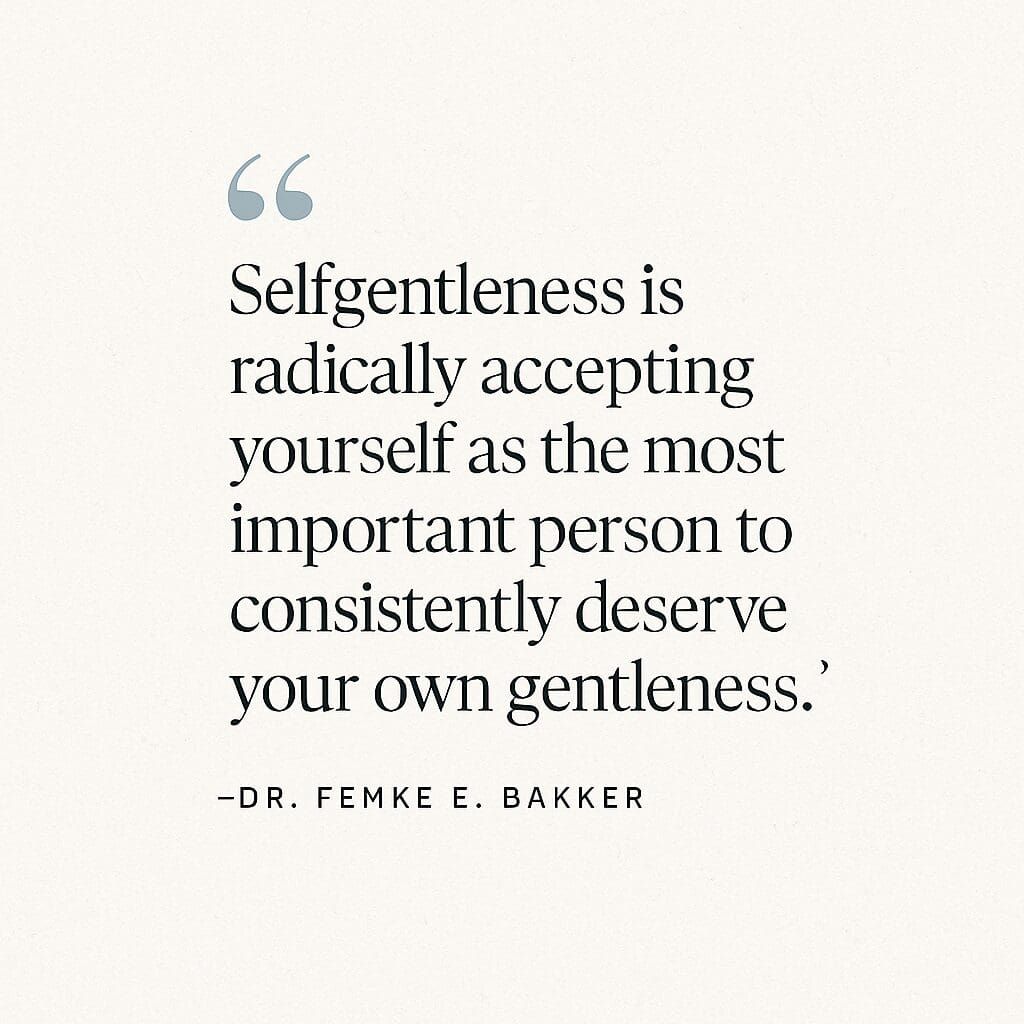
Selfgentleness is radically accepting yourself as the most important person to consistently deserve your own gentleness. Everyone can imagine being gentle with themselves. When you have a success, get a compliment, feel proud of an achievement. And that’s good. It gives you a reference point.
So that when you trip and fall, make mistakes, get blamed for something, you can recognize that you’re not selfgentle. That is exactly the moment where selfgentleness can make a difference. To soothe yourself so that you’ll feel a bit better. So you can find those comforting thoughts, which will make you feel more at ease. And to allow yourself to make mistakes, and be inconsistent. To deeply know that you’re worthy beyond means, without having to earn it first.
How Can You Start Practicing Selfgentleness?
It begins with the simple practice of Tuning In:
- Tune In
Pause. Breathe. Ask yourself: What am I feeling right now? What do I need? - Acknowledge
Let whatever comes be okay. No fixing. Just awareness. Yes, I feel tired. Yes, I feel lonely. Yes, I feel like saying no. - Honor
Give yourself what you need, or at least stop pretending you don’t need it. That might taking a break when your feet hurt. Saying no if that feels right, no matter their response. Saying yes when it something makes you feel good, even if everyone thinks it’s bad for you. Asking for help, even when you can do it by yourself. Going to bed early. Or just letting yourself feel.
You don’t have to get it right. You just have to notice when you’ve gone hard on yourself again. And then find your way back to ease and selfgentleness.
That’s the practice.
That’s the power.
It’s Not Self-Care. It’s Self-Truth.
Selfgentleness isn’t another thing to do. It’s giving yourself the permission to stop doing what hurts.
And when you do that, everything changes. People often conflate selfgentleness with self-care, or self-compassion. But selfgentleness is more than that. It’s a perspective, a paradigm if you will. One that encompasses care, compassion and kindness for yourself.
Selfgentleness is about remembering who you are beneath the expectations, the stories, the masks. It’s about meeting yourself where you are, as you are, especially on the hard days.
And it’s about learning to believe (truly) that you’re allowed to be who you are. Always. No matter what.
Want to Begin?
Curious where you are in your selfgentleness process right now? I made a short quiz that might help you see yourself a little more clearly. Take the quiz here.
More Questions?
You might still be wondering…
What does selfgentleness actually mean?
It’s the daily practice of treating yourself with care, especially when it’s hardest to do so. That means listening to what you need, honoring your limits, and speaking to yourself with the kindness you’ve given everyone else for years.
Is selfgentleness the same as self-care?
Not quite. Self-care is often about what you do. Selfgentleness is about how you meet yourself in every moment, whether you’re brushing your teeth or navigating a hard decision. It’s an inner posture, not a to-do list.
Is being selfgentle selfish?
No. In fact, it’s the opposite. When you’re truly selfgentle, you stop abandoning yourself to meet other people’s needs. And from that grounded place, you can give what’s yours to give. Freely, not from depletion.
How do I know if I need selfgentleness?
If you’re exhausted, over-responsible, or still hear that inner voice saying “not enough”… this is your sign. Selfgentleness meets you exactly where you are, and helps you build a life that actually fits.
You can also take a look on the Selfgentleness page of my website, there is a FAQ section there as well.
One Last Thing
You don’t need to earn your worth.
You don’t need to do it all perfectly.
You just need to come back to yourself, again and again, with care.
That’s selfgentleness.
And it changes everything.
All love,
Femke